The Science of The Nap Concert
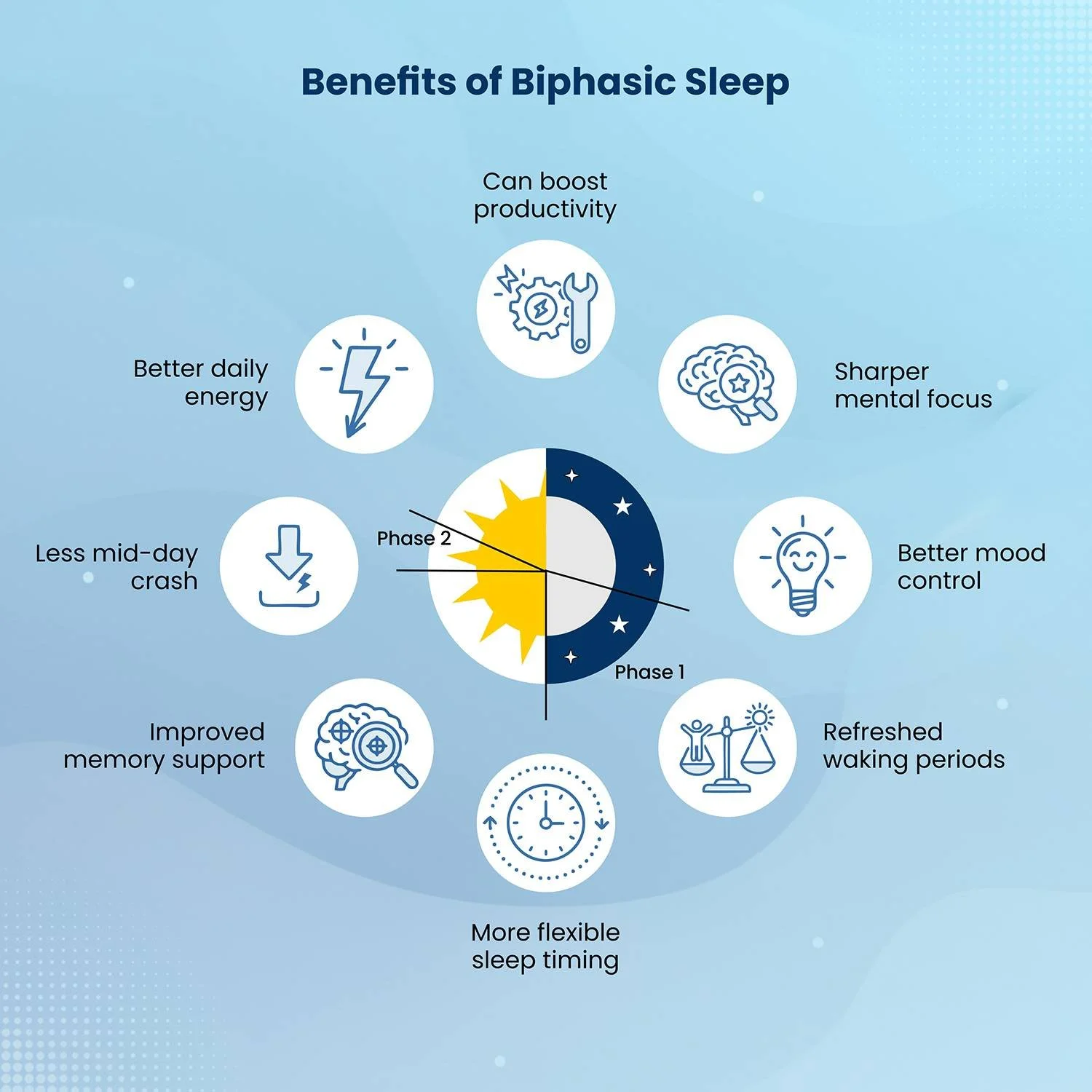
Humans were biologically designed to sleep twice a day.
The Lie We Were Sold About Sleep
We were told that the gold standard of human rest is eight uninterrupted hours. A solid, seamless, unconscious block from darkness to dawn.
Wake up in the middle of the night?
Something is wrong with you.
Take a nap after lunch? You must be lazy.
Feel that afternoon crash around 2 PM? Have a snack and just push through it.
But the science (and the history) actually says: we were never built to sleep this way.
The single consolidated sleep block that modern society treats as biological gospel is, in fact, a remarkably recent invention. It’s a product of the Industrial Revolution.
First Sleep, Second Sleep: What Our Ancestors Knew
Before the clock on the wall told us when to be productive and when to stop…human beings slept differently.
Historian A. Roger Ekirch spent decades combing through over 500 historical documents: Legal depositions, personal diaries, medical texts, and literary works. From ancient, medieval, and early modern societies. What he found was consistent across cultures and continents: humans historically slept in two distinct phases, separated by a period of quiet wakefulness early in the morning or in the middle of the night.
They called it first sleep and second sleep.
The references appear everywhere once you start looking for them. In Homer's Odyssey. In Virgil's Aeneid. In the works of Livy, Thucydides, and Apuleius. In Elizabethan England, the division between first and second sleep was so commonplace it required no explanation. The period between the two sleeps was not wasted time. People used it to pray, reflect, interpret dreams, write, visit neighbors, make love, or simply lie in quiet contemplation. It was considered the most vivid and creative hours of the human day.
This was normal. Dedicated creative hours in the day were considered normal!
What Science Has Confirmed
In 1992, sleep scientist Thomas Wehr conducted a groundbreaking experiment. He took seven healthy men and confined them to 14 hours of darkness per day for one month, simulating the conditions of pre-industrial life before artificial lighting.
The results were striking.
After an initial period of catching up on accumulated sleep debt, the participants naturally shifted into a biphasic pattern. They slept approximately four hours, woke for two to three hours in a state of calm wakefulness, then slept another four hours until dawn.
Their bodies did this without instruction. Without prompting. Without a sleep coach or a wellness app.
Because it was already within them.
The afternoon dip you feel around 2 PM…you know, the one you’ve been taught to fight with a third cup of coffee? That is not a personal failing. Researchers believe it is an evolutionary remnant of our natural biphasic rhythm, a built-in signal from your nervous system that it is time to rest.
Your body has been trying to tell you something.
We have just been trained not to listen.
How the Industrial Revolution Stole Our Sleep
So how did we get here?
The answer is not a mystery. It is capitalism. #restisresistance
As the Industrial Revolution took hold in the 18th and 19th centuries, the human body became a unit of output. Factories needed workers present for specific, consolidated hours. The spread of gas lighting (and later electric lighting ) extended the productive day far beyond sunset and shattered the natural darkness our circadian rhythms depend on.
Sleep became utilitarian. Its purpose was to fuel the next day's labor. The faster you got through it, the better.
Historian Craig Koslofsky documented how street lighting transformed nighttime from a liminal, communal space into an extension of the workday. And slowly, over the course of about a century, consolidated sleep was reframed as normal, and everything else became a disorder. Waking in the middle of the night? Insomnia. Needing a nap? Laziness.
We were not failing at sleep. We were failing to conform to a schedule designed for machines. Not humans!
The Cost of Going Against Our Biology
The consequences have been enormous.
We are living through a sleep deprivation epidemic that is quietly woven into the fabric of every health crisis we face. Chronic sleep deprivation is linked to cardiovascular disease, metabolic disorders, depression, anxiety, immune dysfunction, and cognitive decline. The CDC has called insufficient sleep a public health epidemic!
And yet we continue to treat the symptom, without ever questioning the root cause: a cultural system that designed the human schedule around industrial output, not human biology.
Some researchers have even suggested that our modern multibillion-dollar reliance on sleeping pills may be a direct consequence of our collective resistance to our natural segmented sleep rhythm. We medicate ourselves into the sleep pattern the economy demands rather than the one our bodies were built for.
Getting Back to Our Natural Rhythm
So what do we do with all this?
First: permission. Give yourself permission to stop treating your body's natural signals as problems to be fixed. That afternoon drowsiness is not weakness. That mid-night wakefulness is not dysfunction. Listen to your body and give yourself permission to obey it.
Second: the nap. A brief, intentional rest in the afternoon (even 15 to 30 minutes) does not make you unproductive. NASA research found that a 26-minute nap boosted performance by 34% and alertness by 54% in astronauts. The most elite professionals on earth were prescribed rest. Why are the rest of us still apologizing for needing it?
Third: darkness and rhythm. Our circadian systems are regulated by light. Artificial lighting at night suppresses melatonin and delays sleep onset. Small changes like dimming lights after sunset, limiting screen exposure before bed, spending time in natural light during the day. This can begin to recalibrate what the Industrial Revolution disrupted.
Fourth: community. One of the most overlooked aspects of pre-industrial sleep culture is that it was social. The watch between first and second sleep was not spent alone, staring at a ceiling in anxiety. It was spent in quiet conversation, prayer, reflection, or connection. Rest was woven into community. We lost that too.
Rest Is Not a Reward.
I built The Nap Concert™ as a direct response to a system that has pathologized our most basic biological needs and called our exhaustion a character flaw.
Biphasic sleep is not some ancient curiosity. This is the evidence that the human body has always known something our culture has worked very hard to make us forget: rest is not what you earn at the end of productivity. Rest is the foundation of it.
When we nap together: lying in a curated space, held by music and community and intentional stillness. We are not escaping the world. We are remembering something older than the industrial clock.
Something that was ours long before anyone told us it wasn't.
Your body was never meant to sleep this way. Maybe it is time to listen to what it is asking for instead.
💜 With gratitude,
Elizabeth Wangugi
Founder, Exclusive Excursions
L. Elizabeth Wangugi Étienne is the Founder & CEO of Exclusive Excursions and creator of The Nap Concert™
